We accept Visa, MasterCard, and American Express credit and debit cards for your convenience.
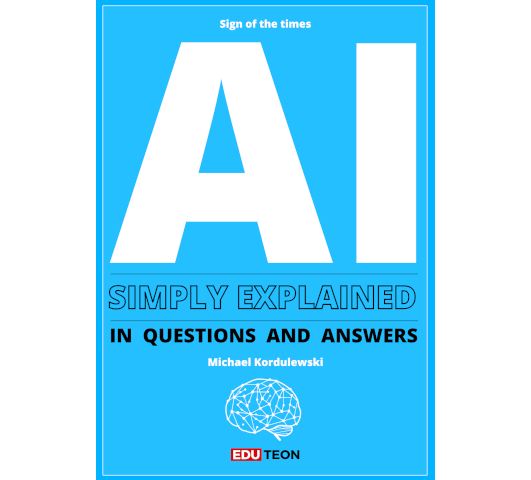


AI. Simply explained in questions and answers
$9.95
🧠 Artificial Intelligence isn’t the future. It’s now.
📘 “AI. Simply Explained in Q&A” gives you the essential knowledge to navigate a world increasingly powered by machines. Whether you’re curious or cautious—this book is for you.
- ✅ Learn how AI affects jobs, privacy, and decision-making 💼🔐📊
- ✅ Understand natural language processing, deep learning & more 💬🤖
- ✅ Demystify terms like tokenization, models, and data training 📚🧩
- ✅ Includes real-life examples and case studies 📷🏥🎮
- ✅ Accessible to all—no tech skills needed 👐🧠
- ✅ Built for modern readers—short sections, clear language, instant clarity ✅📘
🎓 Knowledge is power.
- Author:Michael Kordulewski
- Pages:406
- Language:English
- Format:PDF
- Level:Beginner
- Publishing House:Eduteon
- Table of contents
- Preface
- Chapter 1. General Questions About AI
- What is AI, exactly?
- How does artificial intelligence work?
- Is AI the same as robots?
- What are some examples of AI in daily life?
- Chapter 2. General Concepts of AI
- What is the Brief History of Artificial Intelligence?
- What is Machine Learning?
- The choice remains, as it always has, ours
- What is Deep Learning?
- What are the main goals of Artificial Intelligence?
- What is the difference between weak AI and strong AI?
- What are the main types of AI (narrow, general, superintelligent)?
- How does AI differ from machine learning and deep learning?
- Chapter 3. The Most Known AI Models
- What is ChatGPT?
- What is Gemini?
- What is DeepSeek?
- What is Qwen?
- What is Copilot?
- What is Claude?
- What is Grok?
- What is Mistral?
- What is LLaMA?
- What is Midjourney?
- What is DALL·E?
- What is Stable Diffusion?
- What is Sora?
- What is Whisper?
- Chapter 4. Technology & Functionality
- Can AI make mistakes?
- How do AI systems learn?
- What is Natural Language Processing, and what does NLP mean?
- What kind of data does AI need?
- What is Tokenization?
- What is Embedding?
- Chapter 5. Data in AI
- Why is data important in AI development?
- What is Training Data?
- What is a Validation Set?
- What are the steps of data preprocessing?
- What is feature engineering?
- How do you handle missing or noisy data?
- Chapter 6. Types of AI Models
- What is reinforcement learning?
- What is Generative Model?
- What is the difference between supervised and unsupervised learning?
- How do neural networks work?
- Chapter 7. Neural Networks and Deep Learning
- What is a Neural Network?
- What is Transformer?
- What is backpropagation in neural networks?
- What is Gradient Descent?
- What is a Seed?
- Chapter 8. Training and Optimization
- What is Pre-training?
- What is Fine-tuning?
- What is model training in AI?
- How do you prevent overfitting in machine learning?
- What is Overfitting?
- What is Underfitting?
- What is Loss Function?
- What is model evaluation and which metrics are commonly used
- Chapter 9. AI Architecture Overview
- What is the architecture of a typical AI system?
- What is Model Architecture?
- What are the key components of an AI architecture?
- How does data flow in an AI model?
- What is a pipeline in AI system design?
- How do AI systems integrate with other software systems?
- Chapter 10. Language & Communication
- Can AI translate languages correctly?
- Will AI help me learn a new language?
- Can AI understand my accent?
- Chapter 11. Language & Generative Models
- What is Language Modeling?
- What is Masked Language Model (MLM)?
- What is Causal Language Model (CLM)?
- What is an Encoder-Decoder Architecture?
- What is a Context Window?
- What is a Token Limit?
- Chapter 12. Tools and Frameworks
- What is TensorFlow used for?
- How does PyTorch differ from TensorFlow?
- What are the most common frameworks used in AI development?
- What are AutoML tools?
- What is the role of cloud platforms in AI?
- Chapter 13. AI Deployment and Usage
- How is an AI model deployed to production?
- What are the challenges in AI deployment?
- What is edge AI?
- What is model drift and how can it be handled?
- How do you monitor an AI system in real-time?
- Chapter 14. Advanced Techniques
- What is Zero-shot Learning?
- What is Few-shot Learning?
- What is Prompt Engineering?
- What is Inference?
- What is Model Compression?
- What is Transfer Learning?
- What is Knowledge Distillation?
- What is Multi-modal Learning?
- What Is Augmentation?
- Chapter 15. Ethical and Societal Aspects
- What is Bias?
- How can bias be introduced in AI models?
- What is Hallucination in AI?
- What is Alignment in AI?
- How can AI systems be made fair and transparent?
- Chapter 16. Future and Advanced Topics
- What is Scalability in AI systems?
- What is Compute Efficiency?
- What are the future trends in AI?
- What is AGI (Artificial General Intelligence)?
- What is OpenAI?
- What is GPT (Generative Pre-trained Transformer)?
- What is LLM (Large Language Model)?
- What is BERT (Bidirectional Encoder Representations from Transformers)?
- What is an Autoregressive Model?
- What is Emergent Behavior?
- Summary
- Publisher’s Note
Your e-book will be delivered straight to your email as soon as the payment is confirmed — so you can start reading almost immediately!
No eBook reader is required. The book is delivered as a PDF file, which means you can open and read it on any device that supports PDF documents—such as your computer, tablet, or smartphone. All you need is a basic PDF reader, which most devices already have installed.
If you have any questions or run into any issues with your purchase or accessing your e-books, feel free to reach out to us:
📧 Email: support@simplyexplainedbooks.com
📞 Phone: +48 452 909 001
Absolutely. You can request a return within 7 days — no questions asked.